
Thursday, September 16, 2010
[Book Review] SARAH’S KEY by Tatiana de Rosnay

Julia Jarmond, an American transplant and journalist, begins researching the 1942 roundups of Parisian Jews. She discovers the story of Sarah Starzynski and her family and takes the reader along as she digs deeper into the history of Sarah’s family, the history of her own family and the shameful history of a city under siege.
Sarah Frierson, History Department
Labels: Historical Fiction, Reviews by Sarah Frierson

Tuesday, June 22, 2010
[Book Review] CITY OF THIEVES by David Benioff
 Fiction /Historical
Sarah Frierson reviews CITY OF THIEVES by David Benioff (Viking, 2008)
Lev and Kolya have both been captured for capital offenses in the besieged city of Leningrad during World War II. Rather than face their executions, they can win back their lives if they can accomplish one simple task for a Russian general—bring him a dozen eggs for his daughter’s wedding cake. Did I mention that they were in Leningrad during the war? Not such a simple task, really.
This book is at times brutal and yet, at other times, deeply humorous—a coming of age story set within a war story. Benioff’s experience as a screenwriter is apparent, and a movie will take shape in your mind as you read it.
Sarah Frierson, History Department
Labels: Historical Fiction, Reviews by Sarah Frierson
Wednesday, May 19, 2010
[Book Review] ZEITOUN by Dave Eggers
 Nonfiction
Sarah Frierson reviews ZEITOUN by Dave Eggers (McSweeney’s Books, 2009)
I recommend this book not because you will enjoy reading it. In fact, I guarantee you will not. But it is a book that everyone should read. Don’t get me wrong, it is a wonderfully well-written book and it will fly by from the moment you read the first chapter. But it is very painful to have to experience even a moment of what Abdulrahman Zeitoun experienced during and after Hurricane Katrina.
Eggers is able to masterfully tell this story that touches on family, faith, and the responsibility of a government, all while giving the readers a chance to step into the shoes of one who lived it, if only for a moment.
Sarah Frierson, History
Labels: Nonfiction, Reviews by Sarah Frierson
Monday, February 25, 2008
[Book Review] THUNDERSTRUCK by Erik Larson
 Nonfiction/Crime & Criminals
Sarah Frierson reviews THUNDERSTRUCK by Erik Larson (Crown Publishers, 2006)
Erik Larson amazed me with the very popular The Devil in the White City by his ability to weave together two seemingly disparate tales to create a very engaging nonfiction read. So I was very excited to finally get the chance to sit down and take in Thunderstruck.
Thunderstruck again tells two very different stories, not noticeably connected except for their setting in turn-of-the-century London, until a climactic intersection at the end of the book. First, there is the story of Guglielmo Marconi and his quest to send wireless messages across the Atlantic. Although not a trained scientist, Marconi had a good idea and then spent years using a trial-and-error approach to bring it to fruition. Larson explains not only Marconi's efforts to perfect wireless telegraphy, but also his fight to form a company and fend off competition and scrutiny from more established members of the scientific community.
The other half of this complex tale is Dr. Harvey Hawley Crippen, a gentle and unassuming homeopathic doctor and his wife, Belle Elmore, a woman as overwhelming as he is mild. When Belle suspiciously vanishes, their community is shocked by what the investigation uncovers.
I don't want to give away too much of the story, but it all culminates in a transatlantic chase that utilizes Marconi's technology not only to apprehend the suspects, but to announce to the world each step of the action as it occurs.
In a world where news is instantaneous and wireless communication is considered standard, this story is a nice reminder of the novelty of such ideas and the wonder that once accompanied both the possibility and the eventual reality of the new technology.
Sarah Frierson, Business and Science Department
Labels: Crime and Criminals, Nonfiction, Reviews by Sarah Frierson
Wednesday, January 02, 2008
[Book Review] A LONG WAY GONE by Ishmael Beah
 Nonfiction/Memoir
Sarah Frierson reviews A LONG WAY GONE: Memoirs of A Boy Soldier by Ishmael Beah (Farrar Straus and Giroux, 2007)
Ishmael Beah lived in a small village in Sierra Leone. At a very young age, his life was interrupted by the political and social turmoil around him. On what began as a very normal day, Beah found himself without his family, his home or a sure path to safety. After months of wandering, scavenging for food and awaiting his own death at the hands of the rebels or fearful civilians, he was recruited by the army to fight. As a soldier, he was armed with weapons and drugs and taught to kill. Fortunately, he survived his conscription, eventually being released to an NGO rehabilitation program and taught how to once again be a child.
Beah’s first-person account is remarkable first and foremost because he lived to tell his story, which he recounts in hopes of eliciting change and protecting other children. But what is most incredible is his ability to take the reader down the path he was forced to tread. His impressive skill as a writer allows each reader to feel the fear of a night alone in the forest or the sorrow of losing a friend.
At times, reading this story can be overwhelming. But, one must only glance at the picture of Beah on the back of the book to regain a sense of hope. This young man’s smile alone gives a sense that anything can change for the better and that hope can never be lost. Perhaps his story is a story that must be told and retold until everyone is safe on the other side.
Sarah Frierson, Business and Sciences Department
Labels: Memoir, Nonfiction, Reviews by Sarah Frierson
Monday, December 10, 2007
[Book Review] THE LAST SEASON by Eric Blehm
 Nonfiction
Sarah Frierson reviews THE LAST SEASON by Eric Blehm (HarperCollins, 2006)
Randy Morgenson spent 28 seasons as a backcountry ranger in the High Sierras. It's possible to say that no one knew more about the area and what it took to survive there than him. Without a doubt, no one had a greater love for the land. So no one expected what happened in the summer of 1996.
Randy Morgenson vanished.
Did he want to disappear? Was there an accident? Could he have been murdered? Did problems from the off-season spill into the backcountry and lead him to suicide?
All of these questions are confronted as this book combines the mystery of Randy's disappearance with the story of Randy's life, the tales of the backcountry and an intricate portrait of a modern search and rescue mission. Eric Blehm pieces together parts of Randy's own journals and logbooks with hundreds of interviews of friends, family and coworkers to combine each of these parts of the story seamlessly.
Blehm does a good job of building suspense and propelling the reader deeper into the book, so anyone who likes a mystery will probably enjoy this book. But, for those who have any interest in the outdoors, national parks, search and rescue operations, or anyone who has enjoyed Jon Krakauer's books, you are sure to like it!
Sarah Frierson, Business and Science Department
Labels: Nonfiction, Reviews by Sarah Frierson
Wednesday, August 29, 2007
[Book Review] THE YEAR OF MAGICAL THINKING by Joan Didion
 Nonfiction
Sarah Frierson reviews THE YEAR OF MAGICAL THINKING by Joan Didion (Knopf, 2005)
Life changes fast.
Life changes in the instant.
You sit down to dinner and life as you know it ends.
Joan Didion lost her husband of forty years, writer John Gregory Dunne, on December 30, 2003, at a time when her only daughter was in a coma. This book is her raw account of the year that followed. The reader travels through the stages of Didion's grief with her--from the necessary, intense, distracting focus on her daughter's life-threatening condition to the moments filled by incapacitating memories.
But most of all, Didion wants to understand what happened, what could have been corrected. Ultimately, she wants to understand what it will take to reverse time and bring her husband back. In her search for explanation, Didion methodically approaches this new experience as she has any other--she goes to the literature. She uses existing literature, both popular and clinical, to help her rationalize that which is not rational--the death of her partner.
This is not a guide for people experiencing grief. Neither is it a sentimental journey through the lives of these two authors. But it is very poignant account of one woman's journey through loss. And it is a love story. The little things shared by two who are so inseparable, the way their lives are so entwined...these little bits tell the story of two lives before that horrible day.
Sarah Frierson, Business & Sciences Department
Labels: Nonfiction, Reviews by Sarah Frierson
Wednesday, June 06, 2007
[Book Review] THE HISTORIAN by Elizabeth Kostova
 Fiction/Horror
Sarah Frierson reviews THE HISTORIAN by Elizabeth Kostova (Little, Brown and Co., 2005)
I love historical fiction. A friend who knew about my affinity suggested that I read this book. And since he mentioned that vampires were a central theme—not a normal reading subject for me—I began this book with some trepidation. But, almost immediately, I was drawn in by Kostova's storytelling.
Using Bram Stoker's Dracula as a springboard, Kostova offers a sprawling tale filled with people and places, all of which play a part in the mystery of what became of Vlad the Impaler, the historical Dracula. The story begins in Amsterdam in 1972 with a young girl's discovery of her father's search for Dracula. Eventually, through letters, the story is actually told by three separate narrators from three different eras. The reader is carried along with each narrator to vividly described locations—including Romania, Bulgaria, Turkey and France—and offered the complex histories that accompany each location along the way.
Much like The Da Vinci Code, this novel asks that the reader suspend a bit of disbelief in exchange for a thrilling ride, but Kostova's thorough research makes that very easy to do. She succeeds at creating a number of smaller mysteries to accompany the one big question—"Is Dracula real?" And those smaller mysteries are just as enticing.
Sarah Frierson, Business and Sciences Department
Labels: Historical Fiction, Horror, Reviews by Sarah Frierson
Wednesday, April 11, 2007
[Book Review] A HOPE IN THE UNSEEN by Ron Suskind
 Nonfiction/African-American Subjects Memoir
Sarah Frierson reviews A HOPE IN THE UNSEEN: An American Odyssey from the Inner City to the Ivy League by Ron Suskind (Broadway Books, 1998)
Cedric Jennings was a student at Ballou, one of Washington D.C.'s roughest inner-city schools, where kids rarely graduated and crime was rampant. A bright young man, he never fit in to such an environment; he stuck with what he knew--his faith, his mother, math, music--and he placed his sights beyond Ballou. He set the impressive goal of getting to the Ivy League.
Cedric did accomplish his goal, getting accepted to Brown University, but he soon found that he still faced many of the same issues--loneliness, feeling out-of-place, insecurity, etc. And, he was no longer the brightest student in the classroom.
Ron Suskind, winner of a Pulitzer for his articles about Cedric in the Wall Street Journal, followed the young man for almost four years to capture this journey. What results is a very honest account of life at the bottom, the hope for the future and the realities of accomplishing mighty goals. Most importantly, Cedric's story shows that the most important step is to become comfortable in one's own skin.
Suskind does not present a glossed-over account of any person (or institution, for that matter). Instead, he offers insight, based on hundreds of interviews, into the motivations and emotions that guide each of the people in the story. Readers from varying racial, economic and social perspectives are offered this insight to gain a better understanding of the barriers our youth often face as they try to reach their goals.
Sarah Frierson, Business and Science Department
Labels: African-American Nonfiction, Memoir, Nonfiction, Reviews by Sarah Frierson
Wednesday, March 14, 2007
[Book Review] TENDER AT THE BONE by Ruth Reichl
 Nonfiction/Cooking Memoir
Sarah Frierson reviews TENDER AT THE BONE: Growing up at the Table by Ruth Reichl (Random House, 1998)
I first encountered Ruth Reichl's writing with 2005's Garlic and Sapphires and was immediately impressed. (And hungry! You can only read about food for so long before you want to experience it for yourself.) That book told of Reichl's arrival in New York to work as the food critic for the New York Times and the hilarious disguises she needed to create in order to do her job. Reichl has a wonderful storytelling style, and her love of food and people is abundantly clear.
Tender at the Bone is a collection of stories from throughout Reichl's life, each showing a step in her development as a "foodie" and as a storyteller. From learning how to cook her father's favorite German dishes as a young girl to an elite French boarding school, through communal living in San Francisco to an extended trip to North Africa, the reader is able travel along with Reichl as she begins to discover her passion.
Each story is able to stand alone, but a few threads run through them all--culinary discoveries, the individual's search for identity, and the power of family. Reichl's interactions with her mother help to define her as well as thrust her into new possibilities, and the result is a book that explains how one can find one's calling without knowing that a search has begun.
Also, for those who are more interested in the food, most chapters are augmented with a recipe from that time in Reichl's life. Each recipe is simple and stripped down to the basics, which I appreciate greatly as a beginning cook. I'm looking forward to my first attempt at Wiener Schnitzel. Cross your fingers!
Sarah Frierson, Business and Science Department
Labels: Cooking, Memoir, Nonfiction, Reviews by Sarah Frierson
Friday, November 10, 2006
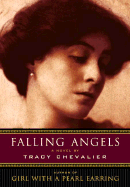
[Book Review] FALLING ANGELS by Tracy Chevalier
 Fiction/Mainstream Historical
Sarah Frierson reviews FALLING ANGELS by Tracy Chevalier (Dutton, 2001):
Falling Angels is Tracy Chevalier's (author of Girl With a Pearl Earring) glimpse into a changing English society during the decade between the deaths of Queen Victoria and King Edward VII. Through the lens of turn-of-the-century funerary tradition, she tells the stories of two neighboring families during this decade in which both progress and changing morals and values caused much controversy.
The Coleman family and the Waterhouse family have adjacent cemetery plots and the reader quickly learns the differences between the two groups. The well-to-do, free-thinking Colemans have placed an elegant urn over their plot while the conventional Waterhouses have chosen a more sentimental angel. Although the families are quite different, they quickly find themselves true neighbors and their daughters, Maude Coleman and Lavinia (Livy) Waterhouse, become best friends.
Chevalier has a knack for intimating the voices of her characters. The story is told in a chronological fashion by each of the characters, including at times the cook, maid and gravedigger. Change and grief are explored, but more interesting are the resulting attitudes and desires that arise.
At its core, this is a novel about women, young and old. Some deal with change by grasping at tradition while others embrace new movements, such as women's suffrage. Despite their different characteristics and approaches, all eventually must travel the through the same turmoil and despair to get to the other side of the decade.
Sarah Frierson, Business and Science Department
Labels: Historical Fiction, Mainstream Fiction, Reviews by Sarah Frierson


