
Saturday, March 08, 2008
Cake Decorating 101: Selected Titles
 Thinking about getting into a new hobby? How about cake decorating!
I have been decorating cakes for more than two years. I have made sheet cakes, two-layer round cakes, and pound cakes. I got into cake decorating because I love looking at wedding cakes and I wanted to create some of that magic, too. My next project is to work towards making my first wedding cake. First, you need a cake. If you are short on time or just have trouble with making cakes from scratch, The Cake Mix Doctor by Anne Byrn is a great start. With these recipes, you can take a plain, box cake mix and create a cake your mother could have made.
Next, you will need a basic decorating book. Complete Cake Decorating by Angela Nilsen is a wonderful example. Nilsen suggests the tools, ingredients, and techniques that will make your cake the talk of the party. For example, she demonstrates several techniques for using piping to create designs. Also, I have found that Marcianne Miller’s The Artful Cupcake is a great resource. Even though Miller deals with cupcakes, her recipes for cupcakes and frostings are fantastic.
Cake decorating is an adventure--an adventure that will take time and patience. Many times (and I do mean many) your cake will not look the way you want it to look, but just take a deep breath, keep practicing and keeping adding your own special style.
Shelley Moore, Raleigh Branch Library
Anne Byrn, "The Cake Mix Doctor," will be at the Benjamin L. Hooks Central Library on Tuesday, March 11 at 11:00 a.m. More information.
photo credit: Jacob Leistner ("Bunko"), morguefile.com
Labels: Cooking, Nonfiction

Wednesday, March 14, 2007
[Book Review] TENDER AT THE BONE by Ruth Reichl
 Nonfiction/Cooking Memoir
Sarah Frierson reviews TENDER AT THE BONE: Growing up at the Table by Ruth Reichl (Random House, 1998)
I first encountered Ruth Reichl's writing with 2005's Garlic and Sapphires and was immediately impressed. (And hungry! You can only read about food for so long before you want to experience it for yourself.) That book told of Reichl's arrival in New York to work as the food critic for the New York Times and the hilarious disguises she needed to create in order to do her job. Reichl has a wonderful storytelling style, and her love of food and people is abundantly clear.
Tender at the Bone is a collection of stories from throughout Reichl's life, each showing a step in her development as a "foodie" and as a storyteller. From learning how to cook her father's favorite German dishes as a young girl to an elite French boarding school, through communal living in San Francisco to an extended trip to North Africa, the reader is able travel along with Reichl as she begins to discover her passion.
Each story is able to stand alone, but a few threads run through them all--culinary discoveries, the individual's search for identity, and the power of family. Reichl's interactions with her mother help to define her as well as thrust her into new possibilities, and the result is a book that explains how one can find one's calling without knowing that a search has begun.
Also, for those who are more interested in the food, most chapters are augmented with a recipe from that time in Reichl's life. Each recipe is simple and stripped down to the basics, which I appreciate greatly as a beginning cook. I'm looking forward to my first attempt at Wiener Schnitzel. Cross your fingers!
Sarah Frierson, Business and Science Department
Labels: Cooking, Memoir, Nonfiction, Reviews by Sarah Frierson
Saturday, April 29, 2006
MY LIFE IN FRANCE by Julia Child and Alex Prud'homme
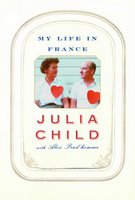 Julia Child and Alex Prud'homme, MY LIFE IN FRANCE (Knopf, 2006).
If you think that Julia Child (1912-2004) was a stuffy, funny-talking old lady, think again.
Many of us struggle to find our calling in life. Julia Child found hers while living in Paris in the 1940s and 50s. She knew little about the culture and her high-school French was limited. Her husband Paul was an excellent tour guide though. He had lived in France before, knew the language, and escorted his wife to many sites and restaurants. Wanting to explore the culture and cuisine independently, Julia took language lessons. She also began to cook more (raised in an upper-middle class family in Pasadena, California, Julia had never been encouraged to do much cooking). She learned about ingredients by exploring local markets and talking extensively with vendors and enrolled in Le Cordon Bleu, the famous cooking school, in 1949. Despite conflicts with the school's owner, a woman more concerned with the bottom line than with training master chefs, something clicked for Julia--she had found her calling:
"I had always been content to live a butterfly life of fun, with hardly a care in the world. But at Cordon Bleu, and in the markets and restaurants of Paris, I suddenly discovered that cooking was a rich and layered and endlessly fascinating subject. The best way to describe it is to say that I fell in love with French food--the tastes, the processes, the history, the endless variations, the rigorous discipline, the creativity, the wonderful people, the equipment, the rituals" (p. 63).
My Life in France will appeal to those who enjoy cooking narratives and travel writing--A Year in The World by Frances Mayes is a recent example. I loved the black and white photographs taken by Paul Child and how they were arranged throughout the text and not in a middle-of-the-book gallery.
This book will also appeal to some fans of biography. It reads like a series of postcards or vignettes. Child details the beginning of her career as a world-renowned chef, television host and author--how she analyzed, studied, practiced, taught and wrote about French cooking. The book's tone (light, descriptive, not overly analytical, not delving too deeply into the darker sides of the author's life and personality) reminded me of the first volume of Langston Hughes' autobiography, The Big Sea.
At the beginning of this review, I suggested that this book might help you to see Child in a new light. Not knowing much about her, I appreciated her efforts to explode stereotypes about French people. She found them to be delightful, friendly, and helpful, in contrast to the views of some of her family and friends.
Also of interest:
Julia Child: Lessons with Master Chefs: A PBS series
Can you recommend any other cooking memoirs?
Doris Dixon, Raleigh Branch Library
Labels: Cooking, Memoir, Reviews by Doris Dixon


