Tuesday, May 24, 2016
[Book Review] Jesus Before the Gospels by Bart D. Ehrman
Nonfiction
Bart Ehrman, Chairman of the Department of Religion at the University of North Carolina and noted New Testament scholar, has written several fascinating books about Jesus and the history of the New Testament, including Misquoting Jesus, Jesus Interrupted, Forged, and How Jesus Became God. They are very interesting and engrossing books, but the arguments and contentions he makes about Jesus and the books of the New Testament and their authors are ones that many Christians, in particular Fundamentalist Christians, must find abhorrent.
In his past books, Ehrman has argued that many of the Books of the New Testament were not written by the authors they are ascribed to; that they were in fact “forged” by unknown authors, who were pretending to write in the name of other authors, including Paul and Peter.
Ehrman has also contended that the books of the New Testament contain many contradictions and inconsistencies. He has also said, contrary to what many may believe, there are no original copies of New Testament writings in existence. What we have are manuscripts which are copies of copies of copies of the original writings. And, none of the copies, he has contended, are accurate because they were “inadvertently and/or intentionally” changed by the scribes who copied them.
And, though, Jesus came to be recognized by the early Christian Church, three centuries after his death, as the Second Person of the Holy Trinity, and thus God Himself, Ehrman has made the argument that Jesus himself never made the claim that he was God on earth.
Readers who did not like his past books are not going to like Jesus Before the Gospels either. If they disagreed with his contentions and arguments in has past books, then they will disagree with his contentions and arguments in Jesus Before the Gospels.
Read more »Labels: Nonfiction, Reviews by Philip Williams, Staff book reviews
Monday, January 04, 2016
[Book Review] The Wright Brothers by David McCullough
Nonfiction/History/Biography
From the first chapter to the last, I found David McCullough's account of the lives of the two brothers who changed history by inventing the airplane a fascinating read. McCullough is a gifted writer who does a wonderful job of telling Wilbur and Orville Wright's story. McCullough includes many passages from the Wrights' letters, diaries and notebooks, as well as passages from letters by their sister Katherine, their father Bishop Milton Wright and from others who knew the famous brothers. So, McCullough often uses Wilbur and Orville's own words, as well as their family members and friends own words, to tell the story of the two fathers of modern aviation.
In an interview published in Air and Space Magazine about The Wright Brothers, McCullough was asked if Wilbur and Orville had notable weaknesses or flaws. He replied that they really did not. They were hard-working, virtuous men. Men of determination and resilience. Though neither man had a college degree both men were geniuses. That the two unassuming bicycle mechanics could accomplish in creating their "flying machines" what human beings over the centuries had only dreamed of, and what many thought impossible, is one of the most remarkable feats in human history.
We learn in the book how important their father Bishop Milton Wright and their sister Katherine were in the brothers's lives. It was their father who fostered an intellectual curiosity in his sons and who provided them access to his great library of books on a wide range of subjects. And it was Katherine who was always there for them, who always encouraged and cared for them, and who they loved dearly.
It is interesting to learn, in the book, that while they read the literature on aviation written by the early aviation pioneers of their day, that an important part of their learning how to fly came from reading about birds and how they fly, and by spending hours observing birds in flight. They saw that birds have vaulted wings which is what gives them control and balance in flight. This observation led them to do a slight warping of the wings of their flying machines to help them maintain a controlled and balanced flight.
It was also interesting to learn about Charlie Taylor, whose contribution makes him an important figure in the Wright Brothers story and the history of aviation. Taylor was also an unassuming man, a machinist in Dayton, hired by Wilbur and Orville to run their bicycle shop while they conducted their experiments with their flying machines at Kitty Hawk, North Carolina. It was Taylor, after the brothers learned to fly their flying machines and were ready to add a motor to their final one at Kitty Hawk, who built, according to Wilbur and Orville's specifications, a four-cylinder, aluminum cast motor from scratch for it.
And as so many are well aware, on December 17, 1903, the first flight of a heavier than air machine in the history of the world was made by the Wright Brothers at Kitty Hawk, North Carolina.
I thoroughly enjoyed this book and I highly recommend it.
Philip Williams, Cordova LibraryLabels: Biography, History, Nonfiction, Reviews by Philip Williams, Staff book reviews
Wednesday, December 23, 2015
[Book Review] The Universe Within by Neil Shubin
Nonfiction/Geology
In The Universe Within, Neil Shubin says that we encounter bodies, rocks, and stars every day of our lives. But he says if we train our eyes each of these entities can reveal deep realities about the nature of our existence and can become "windows to a past that was vast almost beyond comprehension, occasionally catastrophic, and always shared among living things and the universe that fostered them." Inside each of us and inside rocks is the history of the universe, Shubin asserts, and of the events that shaped the natural world and us.
Shubin traces these events in this book. He offers explanations and descriptions of the Big Bang, the formation of the Solar System, the creation of the moon, of the global carbon cycle, of catastrophes that during different periods of the history of the earth have caused mass extinctions of life forms, of plate tectonics, and of other natural events, which have shaped our planet and us. And he does so from the expert view of a scientist but in language comprehensible to the lay reader.
I found the book engrossing and very enjoyable. It is a book dealing with complex scientific subject matters but one that is actually a fast read because of the clarity of Shubin's writing style. It is a profound book because it explains how we can know the reasons why the natural world is as it is and why people are as they are.
I highly recommend this book, as well as Shubin's other book, Your Inner Fish : A Journey Into the 3.5-Billion-Year History of the Human Body.
Philip, Cordova LibraryLabels: Nonfiction, Reviews by Philip Williams
Thursday, July 23, 2015
[Book Review] Finding Jesus: Faith, Fact, Forgery by David Gibson and Michael McKinley
Nonfiction/History
Philip reviews FINDING JESUS: FAITH, FACT, FORGERY: SIX HOLY OBJECTS THAT TELL THE REMARKABLE STORY OF THE GOSPELS by David Gibson and Michael McKinley (St. Martin’s Press, 2015)
Who is Jesus? This is the question explored in Finding Jesus. It's authors emphasize that the question must be asked in the present tense because there are hundreds of millions of Christians today who believe Jesus is alive and in Heaven, where he reigns over the universe.
Almost all that is known about Jesus comes from the Gospels and other early New Testament writings, none of which can be considered unbiased, impartial historical sources. Aside from a couple of short passages about Jesus in the writings of the Jewish historian Josephus (one of which is likely an addition made by a later Christian writer) what else exists that can provide a direct link to Jesus and shed light on his life?
What the authors explore are six Christian artifacts that may indeed provide that direct link to Jesus. There have been countless Christian relics and artifacts that were proven to be fakes since the time of Jesus. But the six artifacts explored in this book are, the authors assert, "themselves of the natural world," which "have the capacity to take us out of ourselves, to transport us to a time and place not our own as we hope to discover something about Jesus that is not filtered through the distorting lens of time and our own desires."
The artifacts explored are: 1) the bones of John the Baptist, 2) the James Ossuary (could James have been the brother of Jesus?), 3) the Gospel of Mary Magdalene (really just some text on a piece of papyrus but the text raises the possibility that Mary Magdalene may have been the wife of Jesus, 4) the Gospel of Judas (this was a gospel from ancient times but one not selected to be one of the canonical books of the New Testament, 5) a piece of the True Cross, and 6) the burial shroud of Jesus known by most people today as the Shroud of Turin. It is fascinating to learn about these artifacts and to know that they may be direct links to Jesus and to consider what they may tell us about Jesus.
This is indeed a most interesting and thought-provoking book. I found it engrossing and I learned much about all of these artifacts, most of which I was not familiar, the Shroud of Turin, along with most people, I am sure, was the one I knew the most about.
To me, though, there seem to be too many questions about these artifacts and their authenticity, which are raised by the authors in their analyses of these artifacts, for them to provide the historical confirmation of the life of Jesus or to shed more light on his life.
But readers may very well find fascinating at what the authors believe these artifacts may tell us about Jesus.
Philip, Cordova Library
Labels: History, Nonfiction, Reviews by Philip Williams, Staff book reviews
Thursday, May 21, 2015
[Book Review] Thirteen Soldiers by John McCain and Mark Salter
Nonfiction/History/Military/Biography
There have been 13 major military conflicts that the United States has been engaged in since its birth as an independent nation. 13 Soldiers offers accounts of the military service of 13 different individuals, 11 men and 2 women, each of whom served in one of the 13 conflicts. Written by United States Senator John McCain and his former aide Mark Salter, the book is not a political work. The authors’ aim is to share the stories of 13 people who were all willing to make the ultimate sacrifice for their country.
Most of the individuals themselves left personal accounts of their experiences, and McCain and Salter use their accounts as the basis for their stories of these men and women. The authors also offer an exploration of what each of the individuals shared in common, even though they each served in conflicts years apart from one another. McCain himself served in combat during the Vietnam War as a Navy Pilot and personally experienced what someone under enemy fire faces.
The authors talk of the hardships, such as lack of food and water and enduring freezing or boiling temperatures, that each of the individuals faced. They talk of the intensity of the friendships that the 13 individuals made with those they served with; and make the point that only someone who has served in combat can understand the intensity of friendships made during such a stressful time of trial. They talk of the 13 individuals seeing the unimaginable results of the horrors of war, sights such as men being blown to pieces, of seeing brains oozing from skulls, and of seeing men trying to hold their intestines inside of their bodies, after they have been wounded. And they talk of each of the 13 individuals facing the fear and terror inherent in any military conflict.
Each of the 13 men and women were truly remarkable people. There is the story of Joseph Plumb Martin who joined the Continental army and remained a soldier in it for the duration of the American Revolution. Martin left a memoir of his experiences that is a primary source for historians of the American Revolution. Sadly, despite his sacrifices, Martin had to fight hard to see that the Congress awarded pensions to the surviving Continental soldiers after the War.
There is the story of Edward Baker, an African-American, who served with distinction in the Spanish-American War. Baker, a former Buffalo soldier, was a member of a regiment of other African-Americans soldiers who had been protecting settlers from attacks by Native Americans in the American West. When his regiment was ordered to Cuba, to help fight the war against Spain, Baker in particular, but also members of his regiment, played a major role in making Teddy Roosevelt’s charge up San Juan Hill the success it was. But Baker and his regiment never received the credit they deserved for the important role they played.
The stories remind us of the debt of gratitude we owe to these 13 individuals and to all members of our military for the sacrifices they have made for their country.
Philip Williams, Cordova Library
Labels: Biography, History, Military, Nonfiction, Reviews by Philip Williams, Staff book reviews
Friday, January 16, 2015
[Book Review] David and Goliath by Malcolm Gladwell
 Nonfiction/Psychology
If you enjoyed Malcolm Gladwell’s previous books, The Tipping Point, Blink, and Outliers, you will enjoy David and Goliath: Underdogs, Misfits, and The Art of Battling Giants. It is just as interesting, thought-provoking and engrossing.
David and Goliath deals with Gladwell’s exploration of the nature of the underdog and how many people faced with what would seem insurmountable challenges find ways to overcome them. One of Gladwell’s main points is that someone who is perceived to be the underdog may not be the underdog at all.
Gladwell offers his analysis of the classic underdog story, that of David and Goliath from the Bible. Gladwell offers a compelling case as to why it was David who had the advantage over Goliath and that it was really a foregone conclusion that David would defeat Goliath.
He explores the cases of people who have dyslexia, the brain disorder that prevents a person from being able to read at all or only with great difficulty. Not really being able to read should have kept David Boies from even going to law school, much less being able to practice law, but Boies is now one of the most famous trial lawyers in the world. His way of overcoming his dyslexia was to develop extraordinary listening skills, and Gladwell also tells how other dyslexics overcame their challenges to become great successes.
Gladwell also talks of how Dr. Martin Luther King and his team faced an entrenched segregated society in Birmingham, Alabama, in 1963, when they fought for the civil rights of Black people there. King and his team were up against Eugene “Bull” O’Connor, the powerful Public Safety Commissioner who had the will and power to block any attempts to end segregation in Birmingham. King faced what seemed overwhelming odds but in the end he and his team, using creative and unorthodox strategies, were able to strike a blow for the Civil Rights movement in Birmingham.
Gladwell offers other fascinating accounts of people who faced other, different kinds of challenges, who seemingly should have failed in life but did not. Gladwell offers the reasons why they did not fail and instead prevailed.
A truly fascinating book and one which many readers I am certain could not put down.
Philip Williams, Cordova LibraryLabels: Nonfiction, Psychology, Reviews by Philip Williams, Staff book reviews
Monday, December 01, 2014
[Book Review] Fierce Patriot by Robert L. O'Connell
Nonfiction/History
Robert L. O'Connell offers a very readable biography of an important figure in American history, William Tecumseh Sherman. Without Sherman's contributions as a military leader and strategist during the Civil War, the United States could have lost the War. As General of the Army, after the War, he oversaw the suppression of the remaining Native American tribes, west of the Mississippi, to ensure the completion of the Trans-Continental and other railroads. With the railroads, Sherman knew the rest of the future United States would be settled by Americans thirsty for new lands.
O'Connell does a superb job of chronicling the life of a complicated and controversial man. Most of the book is devoted to Sherman's role in the Civil War, but O'Connell offers a detailed account of Sherman's complex relationship with his foster father, the politically powerful Thomas Ewing, and with his foster Ewing siblings, including Ellen, who he took as his wife, and with his brother by blood, John Sherman.
It is a well-written, fascinating book, one hard to put down. It is a good introduction to the life of Sherman for anyone not familiar with him. But also one the student of Civil War history would find valuable.
One criticism of the book those readers already familiar with Sherman could have is that O'Connell is too sympathetic to Sherman. Sherman was ruthless and cruel in many ways, and some readers may find O'Connell too forgiving of the man whose policies had tragic consequences for Native Americans and for the millions of bison he ordered slaughtered to eliminate them as a food source for Native Americans.
Philip Williams, CordovaLabels: American History, History, Nonfiction, Reviews by Philip Williams, Staff book reviews
Wednesday, November 12, 2014
[Book Review] Stress Test by Timothy F. Geithner
Nonfiction/History
Stress Test refers to the plan that Timothy Geithner, President Obama’s first Treasury Secretary, had to end the financial crisis that began in 2008. Geithner, though, must also have meant the title to refer to what he faced during the frightening times that could have seen the complete collapse of the United States Finance System. A collapse would have caused a subsequent global depression that would have caused unimaginable suffering for millions in the U.S. and worldwide.
Geithner played a major role, as head of the Federal Reserve New York Bank, before becoming Treasury Secretary, in stabilizing the Financial Crisis. This memoir of his experience during these frightening times is engrossing, and possibly surprising to some, even riveting in parts. His account is very frank and candid and Geithner does not hesitate to talk about his shortcomings and the mistakes he made. But he makes a compelling case for why the actions he took, though politically unpopular and widely criticized by members of the right and left, ended the Financial Crisis and the possibility of a worldwide economic crisis.
Perhaps a book many might suspect to be a difficult read, it is not. In fact, it is a fast read, and Geithner makes comprehensible to the lay reader what leveraging, derivatives, hedge funds and other financial activities are and how they or their misuse contributed to the Financial Crisis. This is certainly an important book, one that all people who want to understand what happened to our Financial System should read. Readers will have to make their own judgments on whether Geithner was right or wrong in his actions and if his advice on how to prevent future financial crises is sound.
Philip, Cordova BranchLabels: History, Nonfiction, Reviews by Philip Williams, Staff book reviews
Thursday, July 24, 2014
[Book Review] How Jesus Became God by Bart D. Ehrman
Nonfiction
Phillip reviews HOW JESUS BECAME GOD: THE EXALTATION OF A JEWISH PREACHER FROM GALILEE by Bart D. Ehrman (HarperOne, 2014)
As with his previous books, including Misquoting Jesus and Forged: Writing in the Name of God, Bart Ehrman offers in How Jesus Became God a book based on Biblical scholarship but very accessible to the lay reader. Ehrman explores the questions of who Jesus himself claimed to be, of who the Apostles and Jesus’ earliest followers believed him to be, of how the belief in his Resurrection by his earliest followers changed their view of who they believed Jesus to be, of who his later, mainly Gentile followers, believed him to be, and of how Jesus, in the third century after his death, came to be seen, by becoming the second person in the Holy Trinity, as God himself.
Ehrman was once a devout Christian but is now an unbeliever, so many Christians would undoubtedly take issue with many of Ehrman’s conclusions. In exploring how Jesus was viewed by his followers, at different times after his death, Ehrman offers a history of Christianity and the New Testament that is fascinating and something even those who disagree with him would probably find interesting. This is a very clearly written book and one profoundly thought-provoking, to say the least.
Phillip, Cordova LibraryLabels: History, Nonfiction, Reviews by Philip Williams
Monday, June 27, 2011
[Book Review] FORGED by Bart D. Ehrman
 Nonfiction/History
Philip reviews FORGED: WRITING IN THE NAME OF GOD: WHY THE BIBLE'S AUTHORS ARE NOT WHO WE THINK THEY ARE, by Bart D. Ehrman (HarperOne, 2011)
In Forged, noted New Testament scholar Bart D. Ehrman presents some seemingly convincing and compelling arguments that explain why some of the books of the New Testament are falsely attributed to authors who did not write them. Ehrman rejects the claim by some scholars that an author writing in the name of another author was a common and accepted practice in ancient times. On the contrary, he says that this was a practice condemned in antiquity and that an author making a false authorial claim was thought to be deceitful and his work was considered a “lie.” Ehrman thinks it is important that people know that many of the books in the New Testament were, in his words, “forged.”
Many conservative and fundamentalist Christians would undoubtedly take issue with Ehrman’s views and contentions. In this book, Ehrman also discusses gospels, letters and other writings that were rejected by the early Church and did not become a part of the canon of the New Testament. Many readers may not know that many of these writings still exist. While rejecting his main arguments, even conservative and fundamentalist Christians could find Ehrman’s discussions of these non-canonical writings fascinating. This is a thought-provoking, controversial book, to say the least, but one lucidly written and very interesting to read.
Philip Williams, Cordova Branch
Labels: Nonfiction, Reviews by Philip Williams
Thursday, April 30, 2009
[Book Review] TRIED BY WAR by James McPherson
 NonfictionPhilip Williams
 reviews
TRIED BY WAR: Abraham Lincoln As Commander in Chief by James M. McPherson (Penguin, 2008)
Leading Civil War Historian James McPherson offers this narrative of Abraham Lincoln’s role as Commander-In-Chief during America’s greatest time of crisis. With no real military background, Lincoln educated himself in military strategy and theory. He proved, during the course of the war, to have a better understanding than most of his generals of the military advantages the Union had over the South and the strategy needed to defeat it. Lincoln’s iron resolve to save the Union is known to all, but McPherson shows that by 1863 Lincoln had transformed the conflict into a War of Emancipation.
Tried by War is certainly not a paean to Lincoln. McPherson does not gloss over the Lincoln’s controversial actions, namely Lincoln’s willingness to violate civil liberties during the war. But McPherson shows why Lincoln, despite facing monumental odds, was able to lead the United States to victory and establish himself as America’s greatest Commander-In-Chief.
Readers who enjoy
Tried by War may also like McPherson’s one-volume history of the Civil War,
Battle Cry of Freedom.
Philip Williams, Cordova Branch Library
Labels: Nonfiction, Reviews by Philip Williams
Tuesday, January 06, 2009
[Book Review] PIECES OF MY HEART by Robert Wagner
 Nonfiction/MemoirPhilip Williams
 reviews
PIECES OF MY HEART: A LIFE by Robert Wagner with Scott Eyman (Harper Entertainment, 2008)
In
Pieces of My Heart, Robert Wagner, "RJ" to his friends, recounts that he first knew he wanted to be an actor when he was 12 years old. He was caddying on a Bel-Air golf course and saw a foursome composed of none other than Clark Gable, Fred Astaire, Cary Grant, and Randolph Scott. His dream came true when he became a contract player at Fox Studios in 1948.
Wagner's fascinating and entertaining account of his life and 60-year acting career is replete with dozens of recollections, stories, and memories of his time in Hollywood, where he was friends with such screen luminaries as Spencer Tracy and Clark Gable. He reminisces about his work in many films and on three successful television shows.
Readers may not know that, as a young man, Wagner had a four-year relationship with Barbara Stanwyck, who was twice his age, and that he later dated Elizabeth Taylor and Debbie Reynolds. Because of a business deal he made with Aaron Spelling in the 1970s, he shared in the considerable profits of the hit TV show "Charlie’s Angels." To younger people, he may be much better known for his work in the popular Austin Powers movies. His dream life, though, was marred by the tragic death of the love of his life, his wife Natalie Wood, and Wagner offers his account of the circumstances of her death, the deep depression it caused him, and his ultimate resignation to it. This engrossing memoir is, in many ways, very moving and written in a very engaging style.
Philip Williams, Cordova Branch Library
Labels: Memoir, Nonfiction, Reviews by Philip Williams
Friday, August 15, 2008
[Book Review] GONE FISHIN' by Walter Mosley
 Fiction
Philip Williams reviews
GONE FISHIN': An Easy Rawlins Novel by Walter Mosley (Black Classic Press, 1997)
19-year-old Ezekiel "
Easy" Rawlins agrees to drive his friend, Raymond Alexander, better known as "Mouse," to Pariah, Texas. Mouse is seeking money from his stepfather so that he can marry his fiancée EttaMae. Along the way, Easy and Mouse pick up two teenagers, Clifton and Ernestine, who are running away from the law. The swamp witch, Momma Jo, and her hunchbacked son Domaque, also play important parts in the story.
Basically a coming-of-age story about Easy and Mouse,
Gone Fishin' is not a mystery per se. Still it contains much that will interest readers, regardless of whether they are Easy Rawlins fans. Learning how Reese Corn, Mouse's cruel stepfather, influenced Mouse and his often violent behavior, forces Easy to confront his own past and his own father, who deserted his family with Easy was still a child. The journey (which includes violence, voodoo and murder) teaches Easy much about life and influences the rest of his life.
Philip Williams, Cordova Branch Library
Labels: Reviews by Philip Williams
Thursday, May 31, 2007
[Book Review] THE OMNIVORE'S DILEMMA by Michael Pollan
 Nonfiction/FoodPhilip Williams
 reviews
THE OMNIVORE'S DILEMMA: A Natural History of Four Meals by Michael Pollan.
"What shall we have for dinner?" This is the seemingly simple question Michael Pollan explores in
The Omnivore's Dilemma. Today, many people have no idea where their food comes from, how it is grown, how it is distributed and how it is processed. They have no idea of the impact that industrial food giants like Conagra and Archer Daniel Midland have on what we eat or how these companies have created what Pollan calls an "industrialized food chain" dependent on petroleum-based fertilizer and pesticides. The industrialized food chain is also dependent on the pharmaceutical industry for the antibiotics needed to keep alive animals raised on "factory farms" in cruel and inhumane ways. Pollan explores the industrialized food industry in his book, the organic food industry (which in many ways is not as different from the industrialized food industry as many might think), food produced on small farms using what Pollan calls "sustainable agriculture," and food obtained through traditional hunting and gathering methods.
The Omnivore's Dilemma is thought-provoking to say the least and it certainly makes the reader aware of the health, environmental, and moral considerations that consumers now face when they decide what to eat.
Philip Wiliams, Cordova Branch Library
Labels: Nonfiction, Reviews by Philip Williams
Monday, May 14, 2007
[Book Review] FOR HERE OR TO GO by Leah Ryan
 Nonfiction/Workers and WorkingPhilip Williams
 reviews
FOR HERE OR TO GO: Life in the Service Industry by Leah Ryan
Leah Ryan, the author of
For Here or To Go, earned a Master's in Fine Arts and is now a teacher. But Ms. Ryan worked for years in restaurants and in restaurant kitchens. She experienced first-hand the drudgery of service industry jobs and of having to live from paycheck to paycheck. In
For Here or To Go, Ms. Ryan has collected essays, interviews, diary entries, and short stories by men and women who work in the service industry. The writers recollect the daily grind at some of the worst jobs in America. In some ways, Ryan's book is depressing and disheartening because of the conditions that these people have to endure, but there is also humor. There are even inspiring stories about people who, despite working crappy jobs, manage to survive and be happy.
Philip Williams, Cordova Branch Library
Also recommended: The highly-acclaimed
NICKEL AND DIMED: On (Not) Getting By in America by Barbara Ehrenreich
Labels: Nonfiction, Reviews by Philip Williams
Monday, October 23, 2006
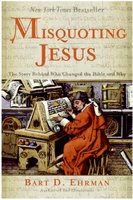
[Book Review] MISQUOTING JESUS by Bart Ehrman
 Nonfiction/ReligionPhilip Williams
 reviews
MISQUOTING JESUS: The Story Behind Who Changed the Bible and Why by Bart D. Ehrman (HarperSanFrancisco, 2005)
Bart D. Ehrman, who chairs the Department of Religious Studies at the University of North Carolina at Chapel Hill, begins his book with a description of the born-again experience he had as a teenager. He chose to go to the conservative, fundamentalist Moody Bible Institute, where the Bible was taught as the inerrant word of God. According to Christian fundamentalists, the Bible contains no mistakes and its very words are inspired by God.
At Moody, Ehrman learned that there are no original writings of the New Testament in existence. What exists are copies of the originals, made, in most cases, many years later. Also, he found out that there is no copy that is completely accurate because the scribes who produced them "inadvertently and/or intentionally" changed them. For Ehrman, this was a compelling problem. If the words of the scriptures are inspired by God, Ehrman believed, we need to know what His words are, not the words of scribes. Erhman became interested in manuscripts of the New Testament and devoted his life to textual criticism, i.e., the scholarly study of Christian manuscripts. Before the invention of the printing press, Ehrman tells us, all copies of New Testament writings were made by hand and the manuscripts contain errors and/or additions, most insignificant, but some that have profound theological consequences for the interpretation of the scriptures.
Ehrman, in his research and study, has reached conclusions that have changed his view of the New Testament writings and how they should be interpreted. This is a fascinating book in many ways, and even fundamentalists, while disagreeing with Erhman’s conclusions, could find his description and history of the field of textual criticism very interesting. Many readers not aware of this history would also find this book compelling, perhaps challenging--and it could possibly change some of their core beliefs about Christianity.
Philip Williams, Hollywood Branch Library
Also of interest--An
interview with Ehrman on NPR's "Fresh Air."
Labels: Reviews by Philip Williams
Saturday, September 23, 2006
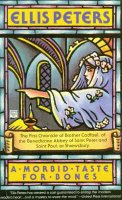
[Book Review] A MORBID TASTE FOR BONES by Ellis Peters
 Fiction/Genre: Historical Fiction MysteryPhilip Williams
 reviews
A MORBID TASTE FOR BONES by Ellis Peters (Morrow, 1977):
Brother Columbanus, a monk in the Benedictine Monastery in Shrewsbury, claims that he has had encounters with Winifred, a Welsh saint, who tells him she is unhappy with the lack of care and dedication her grave receives in the Welsh village of Gwytherin. Brother Columbanus claims that St. Winifred wants her bones to be brought to the Shrewsbury Abbey in England. Another brother, John, is very skeptical of these claims. He believes that the brother is motivated by ambition since having the relic at Shrewsbury would make both the abbey and Columbanus famous.
The Abbot believes that Columbanus has has real visions and sends an expedition of monks to Wales to retrieve the bones of St. Winifred. One of the monks is Brother Cadfael, an herbalist. Before becoming a monk later in life, Cadfael had been a soldier and a sailor and had participated in the capture of Jerusalem during the Crusades. He is part of the expedition because he is of Welsh descent and can speak the language.
In Wales, even though the monks have the approval of the Bishop and the local prince, the people of Gwytherin oppose the removal of the bones to Shrewsbury. Lord Rhysart becomes the chief spokesman for the villagers. He is outraged by an attempted bribe, but he agrees to further discussion with the monks. On the way to a meeting with the monks, Lord Rhysart is murdered. It will be Brother Cadfael, with his detective and forensic science skills, who will solve the murder. And it will be Brother Cadfael who will be instrumental in determining what will happen to St. Winifred's bones.
As the first chronicle of Brother Cadfael, this is the ideal starting point for readers who want to follow the entire series. This book would appeal to anyone who has an interest in medieval times. A reader can learn about life in a medieval abbey, as well as what life was like--the social structure and customs--in a medieval Welsh village. It is an interesting mystery, very well-written, with an intriguing plot and sub-plots, and so readers of mysteries, who never thought about reading historical fiction, could very well like this book. It is certainly not a fast read, however.
Similar authors include Sharon Kay Penman, Michael Jecks, and Sharan Newman.
Philip Williams, Whitehaven Branch Library
Labels: Historical Fiction, Mystery, Reviews by Philip Williams
Tuesday, August 08, 2006
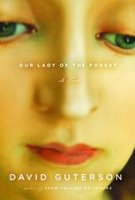
[Book Review] OUR LADY OF THE FOREST by David Guterson
 Fiction/Genre: MainstreamPhilip Williams
 reviews
OUR LADY OF THE FOREST by David Guterson (Knopf, 2003):
Ann Holmes is a 16-year old runaway with a history of drug abuse who lives in a tent ouside North Fork, Washington. Ann claims to have seen the Virgin Mary while picking mushrooms in the forest. Her claim inspires local residents, such as Father Don Collins, the sympathetic local priest, and Tom Cross, an out-of-work logger who has a quadriplegic son. Thousands of outsiders come to North Fork, many of whom believe that miracles are occuring because of Ann's vision. Ann's intense faith and her certainty that she has seen the Virgin Mary have a lasting impact on everyone she encounters.
Our Lady of the Forest is not a light, escapist, or fast read. It is thought-provoking and, although there is some wry humor, the novel deals with serious and philosophical ideas. Because of some sexual content, some readers might be offended by the mixing of sex and religion.
Philip Williams, Whitehaven Branch Library
Labels: Mainstream Fiction, Reviews by Philip Williams


